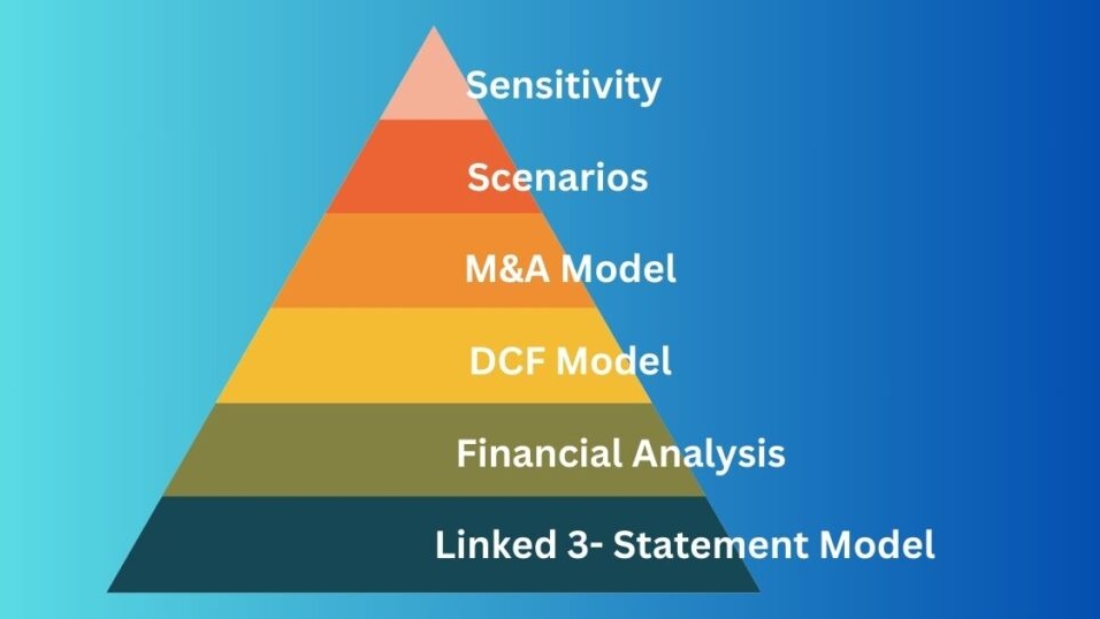
The three-statement model is a foundational financial modeling framework that integrates the income statement, balance sheet, and cash flow statement into a single, dynamically linked structure. It is widely used in corporate finance, investment analysis, and valuation because it provides a comprehensive view of a company’s financial performance, position, and liquidity over time. The strength of the model lies in how changes in one statement automatically flow through to the others, ensuring consistency and accuracy in forecasting and decision-making.
The process typically begins with the income statement, which projects revenues, expenses, and ultimately net income over a given period. Key drivers such as sales growth, cost margins, and operating expenses are estimated based on historical data and assumptions. Net income derived here becomes a critical link, as it feeds directly into both the balance sheet and the cash flow statement.
Next is the balance sheet, which represents the company’s financial position at a specific point in time. It includes assets, liabilities, and shareholders’ equity. In the three-statement model, balance sheet items such as accounts receivable, inventory, and accounts payable are often projected using assumptions tied to revenue or cost drivers (e.g., days sales outstanding). The model ensures that the accounting equation (Assets = Liabilities + Equity) remains balanced throughout the forecast period. Retained earnings, a key component of equity, are updated using net income from the income statement minus any dividends paid.
The cash flow statement is then constructed to reconcile net income with actual cash generated or used during the period. It is divided into three sections: operating, investing, and financing activities. Starting with net income, non-cash expenses like depreciation are added back, and changes in working capital are adjusted to arrive at cash from operations. Investing activities capture capital expenditures and asset sales, while financing activities reflect debt issuance, repayments, and equity transactions.
A critical feature of the three-statement model is the linkage between the cash flow statement and the balance sheet through the cash balance. The ending cash balance from the cash flow statement becomes the cash line item on the balance sheet for the same period. This ensures that all three statements are fully integrated.
In practice, the model is built in spreadsheet software like Excel, with careful attention to formulas and circular references. It serves as the backbone for more advanced analyses such as discounted cash flow (DCF) valuation, scenario analysis, and budgeting. Overall, the three-statement model is essential for understanding how operational decisions impact financial outcomes holistically.